History of El Barrio
Latin Roots Timeline
-Courtesy of Community Works NYC
1625 A colonial Dutch village called New Amsterdam was established in lower Manhattan. Multi- National from its inception, merchants and traders, primarily from Holland, but also from England, Spain, Portugal, France, Germany, Scandinavia, Asia, and Africa, built a center for trade and
commerce at the southern end of Manhattan.
1658 New York State Governor Peter Stuyvesant orders slaves to construct a road to northern Manhattan where a farming community was to be built. The settlers named the community Haarlem, after a Dutch town renowned for its valiant strength and perseverance. The new community of farmers, traders and slave pioneers, began in the region of 110th to 125th streets and the East River.
1664 The British take control of New Amsterdam and rename it New York.
1666 A survey of upper Manhattan is done by the British to mark Haarlem’s boundary. The boundary is officially designated as north of a diagonal line drawn from the sawmill at 74th street and the East River to the Hudson River at 129th street.
1835 The City of New York acquires Randall’s and Ward’s islands. The two islands would go on to become official parts of East Harlem.
1837 The New York and Harlem Railroad is built along Park Avenue.
1852 The Mount Sinai Hospital, one of the country’s oldest and largest voluntary teaching hospitals, is founded as the Jew’s Hospital by Jewish Philanthropists on 5th avenue at 100th street.
1853 A horse-drawn railroad along Third Avenue is chartered to spur development in the East Harlem area.
1870 Rampant land speculation leads to the construction of approximately 65,000 apartments throughout the East Harlem area over a forty year period. The abundance of cheap housing makes East Harlem a magnet for a succession of immigrant groups
1876 The original Polo Grounds stadium is constructed at 111th street between 5th and 6th avenues as a field for playing polo. The stadium would become home to two professional sports teams, the New York Giants and the New York Metropolitans, before moving to 155th street in 1889.
1880 The New York Elevated Railroad extends its Second Avenue Elevated (“the El”) line north to the Harlem River making East Harlem the most inexpensively assessable section of Manhattan.
1880’s Waves of Italian immigrants migrate from the overpopulated Lower East Side for the neighborhoods of East Harlem, replacing the Irish and German settlers that preceded them. Many of these immigrants would settle in the area east of Third Avenue to the River and were followed closely by Eastern European and Jewish immigrants . By the 1930’s, Harlem was home to the largest Italian community in the country.
1895 The Union Settlement is established at 237 E. 104th street by the Alumni Club of Union Theological Seminary to help solve the onset of problems brought on by the rapid urbanization of East Harlem.
1898 The Las Dos Antillas club is formed after the Spanish American war to support independence for Cuba and Puerto Rico. It is an early model of the form of association that would eventually make East Harlem an attractive destination for Puerto Rican immigrants.
1903 Baseball legend Lou Gherig is born in East Harlem on 103rd and 2nd Avenue.
1904 Construction of the IRT subway connects upper Manhattan with downtown.
1913 Storied Hollywood actor Burt Lancaster is born in East Harlem and grows up in a brownstone at 209 East 106th street.
1917 United States President Woodrow Wilson signs the Jones Act into law granting US statutory citizenship to the residents of Puerto Rico.
1919 James Reese Europe’s military band, the musical ensemble credited with formally introducing jazz to Europe, leads the decorated Harlem 369th Infantry Regiment up Fifth Avenue. Among the musicians included in the ensemble is the great Puerto Rican composer Rafael Hernandez.
1919 Thousands of Harlemites gather at the 125th Street pier to cheer the inaugural launch of Marcus Garvey’s Black Star Steamship Line.
1923 Tito Puente, otherwise known as “El Rey” or the “King of Mambo” is born in a Spanish Harlem tenement on 110th street between Madison and Park.
1923 Fiorello H. LaGuardia moves to East Harlem and serves as the district’s representative to the US Congress from 1923 to 1933. LaGuardia eventually settles at 1274 Fifth avenue in 1933 where he remains during the majority of his years as mayor of New York City.
1926 Arturo Alfonso Schomburg, the noted historian and East Harlem resident, sells his collection of books, manuscripts, etchings and memorabilia related to the history of African-descended people to the Carnegie Corporation who donates the collection to start the Schomburg Center for Research in Black Culture in Harlem.
1930’s Puerto Ricans, along with a smaller number of African Americans and West Indians, begin migrating to East Harlem making an immediate impact on the face and culture of the area. By 1950, the new settlers have almost totally replaced the Italians and Jews who had previously characterized the area.
1930’s Congressman Fiorello LaGuardia begins holding election-eve rallies at the intersection of 116th street and Lexington avenue. LaGuardia dubs the intersection the “lucky corner” and the tradition is continued by Vito Marcantonio whose bi-annual gatherings at the corner become celebratory meeting places for the Puerto Rican and Italian communities.
1930 The Park Palace Ballroom, located at 110th street and 5th avenue is rented out to throw a dance party featuring Latin Music and raise funds for political initiatives in the Puerto Rican community. The result is the establishment of East Harlem as a central point for Latin Music and the primary showcase for Latin legends such as Machito & the Afro-Cubans, Tito Puente, Celia Cruz and Pablo “Tito” Rodriguez.
1932 The Museum of the City of New York, the nation’s first museum devoted to New York City history, moves to its present location in East Harlem at 1220 Fifth Avenue between 103rd and 104th streets.
1933 Award winning actress Cicely Tyson is born. Tyson’s childhood home at 178 East 101st street is named in her honor in 1994.
1934 Trailblazing educator Leonard Covello founds Benjamin Franklin High School, East Harlem’s first public high school, at 115th and Pleasant avenue.
1936 Thomas Jefferson Swimming Pool is built by Robert Moses at 112th and 2nd avenue through funds provided by the Works Progress Administration. The pool becomes a lightening rod for racial dissension due to Moses’ insistence that the pool maintain an all-white policy. The eventual integration of the pool becomes a symbol of progress for the non-white citizens of East Harlem.
1936 As part of his plan to eliminate the use of pushcarts to sell products in the streets of East Harlem, Mayor Fiorello LaGaurdia establishes the Park Avenue Market which becomes an important neighborhood center. Predominately Jewish manned and populated at its onset, the market becomes increasingly Puerto Rican and is later rechristened La Marqueta.
1937 Frank Grillo, better known as Latin music king Machito, moves to East Harlem at 111th street and 3rd avenue at the urging of his future brother in-law Mario Bouza.
1937 Vito Marcantonio, outspoken champion of the rights of East Harlem residents born on East 112th street, is elected to Congress as a representative of the 20th district of East Harlem
1937 The Federal Housing Act targets the overpopulated and deteriorating tenements of East Harlem for federal slum clearance. From 1938 to 1958, the New York City Housing Authority razes over 171 acres of slums and replaces them with modern high rise housing projects. The dismantling of tenements, brownstones and other community sites angered many who felt East Harlem lost much its character and identity in the process.
1937 East Harlem Resident Oscar Garcia Rivera wins a seat on the New York State Assembly becoming the first American of Puerto Rican heritage elected to public office in the continental United States.
1937 Angered by a lack of quality public housing, East Harlem residents stage a protest march from East Harlem to City Hall that would go on to become known as the Housing Parade protest march.
1937 Boys Harbour: The Harbour for Boys and Girls is founded as a summer camp for disadvantaged youth. The community-based program grows to become a multi-faceted, education-oriented agency that offers a range of services to youths between the ages of 5 and 21.
1939 Pablo “Tito” Rodriguez moves to East Harlem and soon forms the group Los Diablos del Mambo. Rodriguez goes on to become known as one of mambo’s “big three” with Tito Puente and Machito and as the king of soneos (vocal improvisations).
1940 Oscar winning actor Al Pacino is born in East Harlem.
1941 East River Houses, one of New York’s earliest public housing projects, opens as the first housing project to be built without demolishing existing housing.
1945 It is estimated that families from over 100 countries, speaking more than 35 languages, live in East Harlem.
1946 The SS Marine Tiger passenger ship sails from San Juan, Puerto Rico to New York with 931 passengers. The Marine Tiger would later become an iconic symbol representing the great Puerto Rican migration to New York City.
1947 Langston Hughes purchases a building at 20 East 127th Street and resides there until his death in 1967. The house later becomes a museum known as the Langston Hughes house.
1948 Musician and entrepreneur Bartolo Alvarez establishes Casa Latina, a music and instrument shop that becomes the primary destination for Latin music lovers. In 1962, the store moves to 151 E. 116th street where it continues its reign as the longest-running music store in East Harlem.
1950 The population of East Harlem swells to a historical high of 210,000, a density of 142,000 people per square mile.
1957 Originally entitled East Side Story, the Leonard Bernstein musical West Side Story, the Romeo and Juliet based play that chronicles the tension that resulted from the influx of Puerto Ricans into New York City, opens on Broadway and runs for 732 performances.
1958 The inaugural Puerto Rican Day Parade celebrates the contributions of Puerto Ricans to the history of New York City.
1958 Internationally renown opera singer Marian Anderson moves into a building on Fifth avenue at 101st street and lives there until 1975.
1960s Jose “Cha Cha” Jimenez transforms the Young Lords, a Chicago street gang, into an organization committed to the struggle for human rights and the liberation of Puerto Rico. In 1969, a satellite Young Lords organization is formed in New York City.
1965 Dr. Pedro Albizu Campos, a fiery symbol of the Puerto Rican Independence Movement and former East Harlem resident, dies.
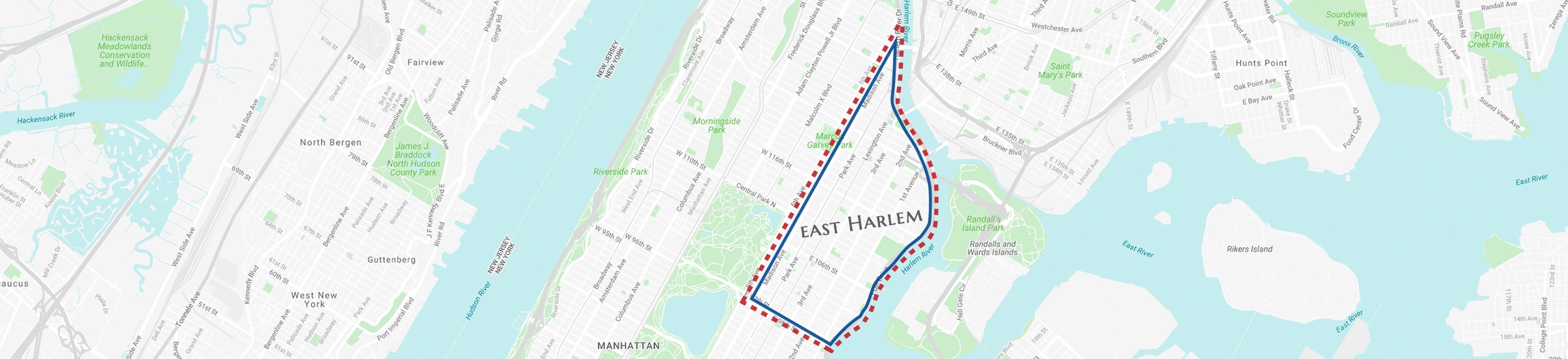
1967 Mayor John Lindsay creates Manhattan Community District 11 which brings three bordering neighborhoods under one jurisdiction. The district includes El Barrio/ Spanish Harlem (East 96th street to 125th street), the area known as the East Harlem Triangle (East 125th street to East 142nd street), Little Italy (3rd Avenue to the Harlem River) and Randall’s and Ward’s Islands. East Harlem becomes the official name of this new district.
1967 East Harlem born Joe Cuba scores a huge hit on the national Hit Parade with his release “Bang Bang”, popularizing the R&B/Latin music fusion style called Boogaloo.
1967 Piri Thomas’ seminal book Down These Mean Streets is published.
1968 A group of childhood stickball players reunite for a game in the area once occupied by the Polo Grounds. The meeting unofficially marks the beginning of the annual Old Timers Stickball Game.
1969 The New York based chapter of the Young Lords Party take over the First United Spanish Methodist Church on Lexington avenue and 111th street and rename it the “Peoples Church”. The Young Lords occupy the church for 11 days and use it to house a free breakfast and clothing program, offer health testing, give classes on Afro-Caribbean history and as a center to promote political and cultural awareness.
1969 Reacting to community complaints that the New York Sanitation department was refusing to service East Harlem, the Young Lords accumulated the uncollected trash and dumped it onto city thoroughfares. Their actions became known as the “Garbage Riots”.
1969 El Museo del Barrio is founded as a place of cultural pride and self-discovery for the Puerto Rican community. The museum would later find a home in the stately Hecksher building at 1230 Fifth avenue and increase its target audience to include visitors of all ethnicities.
1970 Taller Boricua a community based arts and educational organization serving East Harlem through a comprehensive, practical and diversified program for artists and the general public, is established.
1970 Casitas, Spanish for little houses, small wooden dwellings characteristic of homes found in rural Puerto Rico begin appearing across New York City. Casitas, brightly colored and florally decorated, are used as gathering places for community members and represent the efforts of Puerto Ricans to keep cultural ties and traditions alive.
1971 East Harlem raised Herman Badillo becomes the first Puerto Rican voting member of the U.S. House of Representatives, serving until 1976.
1973 Hunter College, a division of the City College of New York University, establishes the Centro de Estudios Puertorriquenos/Center of Puerto Rican studies. The Centro is the world’s only repository of archival and library materials dedicated exclusively to the Puerto Rican diaspora.
1973 Mount Morris Park, which runs from 122nd street to 124th street between 5th and Madison avenue, is renamed Marcus Garvey Park in honor of the black nationalist leader.
1974 Spurred by School District Superintendent Tony Alvarado, Deborah Meier and a group of progressive minded educators found the Central Park East Elementary School in East Harlem’s school district 4. Central Park East represents a new model for urban education that creates mini-schools, with a specifically defined academic focus, within existing larger schools.
1975 East Harlem born Latin music legend Eddie Palmieri wins the first Grammy awarded in the new Best Latin Album category.
1977 El Museo Del Barrio stages its initial Three Kings Day Celebration which features a parade that travels down 106th street, 3rd avenue, 116th street, and Lexington avenue and ends with a production in the Museum’s Teatro Hecksher.
1981 Philanthropist Eugene M. Lang, an alumni of East Harlem’s PS 121, founds the I Have a Dream Foundation with his promise to provide college tuition for 61 sixth graders upon finishing high school.
1982 International competition forces East Harlem’s Washburn Wire Company, one of Manhattan’s largest industrial plants and employer to over 800 workers, to close its doors.
1983 Juan Gutierrez, noted caretaker of the Puerto Rican bomba and plena musical traditions and advocate of traditional Puerto Rican values and identity, forms the musical ensemble Los Pleneros de la 21 with legendary plenero Marcial Reyes Arvelo.
1984 The Memoirs of Bernardo Vega is published. A compilation of the events and observations of Puerto Rican born Vega, the book contributes significantly to the record of events about immigration issues in New York City from the late 19th century to the mid 20th century.
1987 Dr. Georgina Falu founds the Universal Business and Media School at 220 East 106th Street. Dr. Falu, who also established the first internet access center for Upper Manhattan as well as the Falu Foundation, becomes the first Puerto Rican woman of color to start and own a technical school.
1991 Volunteers transform abandoned garbage strewn lot in the heart of East Harlem into two baseball diamonds for neighborhood kids. Their efforts eventually evolve into the founding of Harlem RBI, a nonprofit organization founded to give inner-city youth opportunities to participate in year-round sports, educational and enrichment programs.
1991 The Islamic Cultural Center of New York, the city’s largest Mosque, opens at 1711 3rd Avenue between 96th and 97th streets.
1994 Photographer Joseph Rodriguez releases a photographic journal of East Harlem entitled Spanish Harlem. The book is sponsored by the National Museum of Art and includes an essay by noted writer Ed Vega.
1995 The Upper Manhattan Empowerment Zone, bordered on the east by the East River, on the west by the Hudson River, on the south by East 96th and West 110th street and on the north by 222nd street, is created by the Budget Act of 1993.
1995 The East Harlem Historical Organization, a group of social service, educational, and cultural organizations, historians, and interested individuals dedicated to documenting the historical mosaic of East Harlem is established.
1996 The Young Women’s Leadership School, housed in Metropolis Studios at 106th street between Park and Madison avenue, opens in East Harlem in spite of charges that its constitution violates anti-discrimination laws.
1997 The unveiling of Sculptor Robert Graham’s Duke Ellington Memorial at the 110th and 5th avenue corner of central park marks the first New York City monument dedicated to an African American artist.
1997 The Julia de Burgos Cultural Center opens on the corner of East 106th street and Lexington avenue. The center, founded by director Fernando Salicrup, is named after the Puerto Rican activist, feminist and poet Julia de Burgos who died on the streets of East Harlem.
1998 Efrain Suarez opens El Museo Internacional de la Salsa, the Salsa Museum, on third avenue near 116th street with memorabilia donated by the Latin music community.
1999 East Harlem reared Marc Anthony releases Marc Anthony, his first English language album, and sells over 3 million copies.
1999 The Hollywood film, Music of the Heart starring Meryl Streep, is released. The film chronicles the story of Roberta Guaspari- Tsavaras, a classically trained musician who goes on to start the East Harlem violin program.
2000 East 110th street is renamed Tito Puente Way in honor of the legendary “King of Mambo”.
2003 East Harlem residents flood 125th street in outrage over the proposed closing of Fire Engine Company 36. Originally established in 1888 as Engine Company 14, the firehouse, located at 120 East 125th street, was considered the first response to Harlem’s rapid urbanization at the turn of the century and was designated a landmark site by the New York City Landmarks Preservation Commission in 1991.